
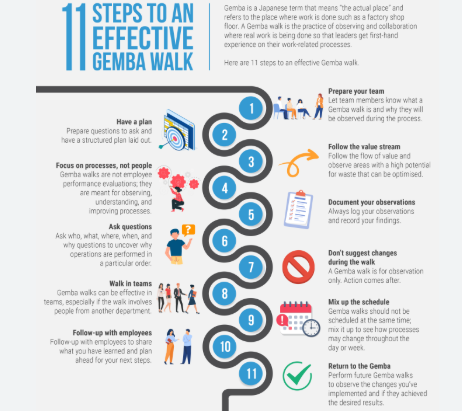
In the world of continuous improvement, few principles are as powerful—and underutilized—as Gemba. From its roots in the Toyota Production System, Gemba (meaning “the real place”) emphasizes the importance of going to where the work actually happens. Whether it’s a shop floor, a call center, or a construction site, the idea is simple: if you want to understand a process, improve it, or support those doing the work, you need to see it for yourself.
Yet visiting the Gemba is only as valuable as your ability to see clearly. That’s where the Lean Waste Checklist becomes essential. Used together, Gemba walks and the Lean Waste framework become a practical and powerful way to drive real improvements—ones that eliminate inefficiencies, boost productivity, and engage frontline teams in the process.
Why Gemba Matters
1. Ground Truth Over Assumptions:
Gemba allows leaders and problem-solvers to observe firsthand how processes really work—not how they’re documented or assumed to work. This direct observation reveals hidden inefficiencies, missed handoffs, unclear instructions, or bottlenecks.
2. Builds Respect and Trust:
When leaders show up on the floor not to judge, but to learn and support, it builds credibility. Team members feel seen, heard, and involved in shaping the solution—leading to higher engagement and better outcomes.
3. Faster, Smarter Problem Solving:
Many challenges cannot be fully understood—or solved—through meetings or spreadsheets. Gemba makes it easier to ask “why?” repeatedly, trace causes, and co-create solutions with the people closest to the work.
The Role of the Lean Waste Checklist
While Gemba provides the lens, the Lean Waste Checklist provides the focus. There are 8 common forms of waste (DOWNTIME), and each one offers a clue that something in the process can be improved:
-
Defects – Errors that require rework or correction
-
Overproduction – Making more than is needed
-
Waiting – Idle time due to delays or poor flow
-
Non-utilized talent – Skills or insights that go untapped
-
Transportation – Unnecessary movement of materials or products
-
Inventory – Excess materials, WIP, or finished goods
-
Motion – Unnecessary movement of people
-
Extra-processing – Doing more than what is required
By using this checklist during a Gemba walk, leaders can identify wasteful activities that might otherwise go unnoticed. It becomes a common language that teams can use to observe, categorize, and prioritize opportunities for improvement.
Turning Observation into Action
Here’s how to combine Gemba and the waste checklist effectively:
-
Schedule regular Gemba walks – Make it a habit, not a one-time event.
-
Go with purpose – Bring a checklist, a notebook, and a learner’s mindset.
-
Engage, don’t interrogate – Ask open-ended questions like:
-
“What’s slowing you down here?”
-
“Is this process consistent every time?”
-
“Where do you see waste in your day?”
-
-
Document what you see – Don’t assume you’ll remember everything.
-
Prioritize with your team – Let the people who do the work help shape the solutions.
-
Follow up – Small, visible improvements build momentum.
Final Thoughts
Gemba is not a management trend—it’s a mindset. When paired with the practical tool of the Lean Waste Checklist, it becomes a daily discipline that can transform operations, culture, and results. Leaders who commit to “go see, ask why, and show respect” consistently uncover better insights, smarter solutions, and more empowered teams.
If your organization is ready to bring Lean to life, start at the Gemba. That’s where real change begins.
📞 Contact GKW Business Solutions
Ready to empower your team with Lean tools, Gemba training, or waste elimination strategies?
GKW Business Solutions can help you implement sustainable systems that drive results.
📧 Email: mcraig@gkwbusinesssolutions.com
📱 Call: Mike Craig at (316) 680-9695
🌐 Website: www.gkwbusinesssolutions.com
Let’s build a culture of continuous improvement—together.