
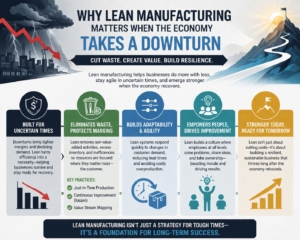
When the economy takes a downturn, businesses are often forced to confront shrinking margins, declining demand, and increased uncertainty. In these moments, operational efficiency becomes not just a competitive advantage but a necessity for survival. Lean manufacturing offers a proven framework for navigating such challenges by focusing on eliminating waste, optimizing processes, and delivering value to customers with fewer resources. Rather than reacting with short-term cost cutting alone, companies that adopt lean principles position themselves for both immediate resilience and long-term stability.
At its core, lean manufacturing is about doing more with less—less time, less inventory, less effort, and less cost—while maintaining or even improving quality. During economic slowdowns, excess inventory, inefficient workflows, and unnecessary steps in production can quickly become financial liabilities. Lean practices such as just-in-time production, continuous improvement (Kaizen), and value stream mapping help organizations identify inefficiencies and remove them systematically. This allows businesses to operate more flexibly and avoid tying up capital in areas that do not directly contribute to customer value.
Another key benefit of lean manufacturing in a downturn is its emphasis on adaptability. Economic instability often leads to unpredictable shifts in customer demand. Lean systems are designed to respond quickly to these changes by streamlining production and reducing lead times. Instead of overproducing and risking unsold goods, companies can align output more closely with actual demand. This responsiveness not only minimizes waste but also helps maintain stronger relationships with customers by ensuring timely delivery and consistent quality.
Lean manufacturing also fosters a culture of employee engagement and problem-solving, which becomes especially valuable during difficult economic periods. Rather than relying solely on top-down decisions, lean encourages input from workers at all levels to identify inefficiencies and suggest improvements. This collaborative approach not only leads to better solutions but also boosts morale, as employees feel empowered and invested in the company’s success. In a downturn, when uncertainty can impact workforce confidence, this sense of ownership can make a significant difference.
Ultimately, considering lean manufacturing during an economic downturn is about building a more resilient and sustainable business. While the initial motivation may be to cut costs, the long-term impact extends far beyond that. Companies that embrace lean principles often emerge from downturns stronger, more efficient, and better prepared to compete when the economy recovers. By focusing on value, eliminating waste, and continuously improving, lean manufacturing provides a strategic pathway not just to survive tough times, but to thrive beyond them.